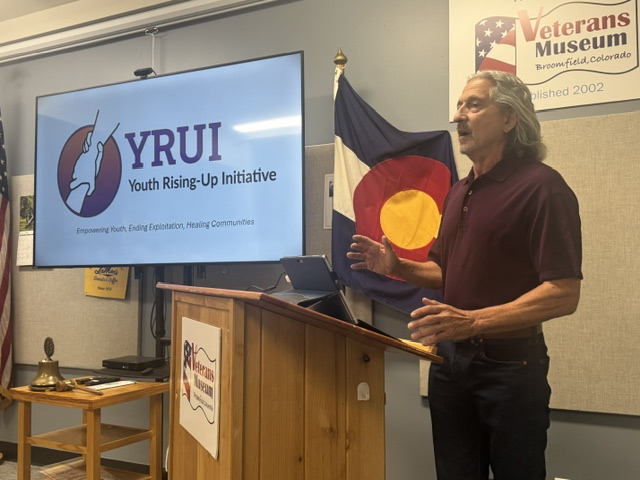
At our regular club meeting on August 13, 2026, held at the Broomfied Veterans Museum, Mitch Peritz of the Youth Rising Up Initiative (YURI) gave a powerful presentation on the state of trafficking of children and what parents can do to help prevent it.
According to Peritz, the average age of girls trafficked in the United States is 11-14. The problem is not limited to girls. Depending on the study, boys now make up 35% - 50% of those trafficked. The boys tend to be a little older, 14-17 on average. They are often the victim of sextortion. Some 95% of those trafficked knew their traffickers beforehand. Often traffickers are family members, coaches, teachers or neighbors. Abduction accounts for only about 3% of trafficking. Colorado ranks high among U.S. states for incidents of trafficking.
Peritz defined trafficking as a severe form of exploitation for labor, often involving force, fraud and coercion, for profit. Risk factors for being trafficked include emotional vulnerabilities, a difficult home environment, instability of the home location, being LGBTQ+, being an immigrant, mental and physical disabilities and language barriers. He also described red flags in a child’s behavior that warrant further inquiry. These include a large increase in withdrawal, specific urgency or mood swings around their phones, strong attachment to an online person, long hours online especially at night, new sexual knowledge or language and worsening apathy, depression or distance. Trafficking increased following COVID. During COVID, kids missed out on socialization and maturation. They experienced persistent loneliness. Many of them went online. This increased depression and suicidal ideation, providing vulnerabilities for traffickers to exploit.
Peritz described some of the tactics used by traffickers. Traffickers often spend 3-9 months grooming victims before trafficking them. First, the trafficker earns enough trust to gain access to the child. Then, after getting access, the trafficker seeks to “bond” with the child, gaining more trust. Then traffickers convince the victim to isolate and keep secrets from family and friends. After that comes a period of sexualization and/or desensitization. Then comes the first request to do something for money. If a child wants out, they are often met with brutality followed by kindness. The child eventually experiences “trauma bond” or Stockholm syndrome, accepting that this must be the price of food, shelter, approval or something else they desperately need. Ultimately, it becomes about making money for the trafficker.
Peritz offered detailed suggestions about steps parents can take to strengthen their children and protect them from trafficking. He repeatedly admonished that “you can no longer be their friends. Your job is to protect them.” Today, teens spend an average of 7 hours per day online. The methods Peritz outlined involve monitoring their online and in-person communications and intervening when something seems “off”.
First, Peritz stressed that it is essential for parents to regularly audit and monitor every online game their children play and every app each child uses. This is not a small task. Children are usually resistant to this at first. Sometimes, it helps to stress that by cooperating, the child may be literally saving another child’s life. That often makes a child feel better about giving up their privacy. Children also must be assured that it is OK to report to a parent, anything that seems off or “creepy”. Peritz maintained that parents should not try to do all of this themselves. He recommended forming digital “neighborhood watches” consisting of 3-7 families, where the parents agree on a uniform set of rules and strictly enforce them in each home. Such rules could include, for example, that everyone turns in their phone at a pre-set time before bed and no phones go into the bedroom at night. Another rule he suggested was a monthly random phone inspection where the parent checks all apps on the phone to see if there are any new ones and goes through online and social media communications. He stressed that parents must have open communications with their children and maintain an environment in which if the child messes up and has inappropriate communications with an adult, the child will feel safe sharing the details with their parents, confident that they (1) won’t be punished for sharing and (2) will be loved no matter what.
Peritz offered three (3) very detailed and informative handouts. Links are provided below:
Online Environments where Grooming Often Begins documents/en-ca/57ce474c-a5e9-4582-9f2f-9899aa49d9d2/1
When Your Child is Secretive, Resistant or At Higher Risk; documents/en-ca/5334b356-b202-4e0b-9091-1e9d12d8edf3/1
A list of apps and approaches that can be used to protect children from trafficking. documents/en-ca/d4af7b68-00d7-49d3-9492-868691e3a430/1
For more information about the topic, visit their web site at yuri.org.