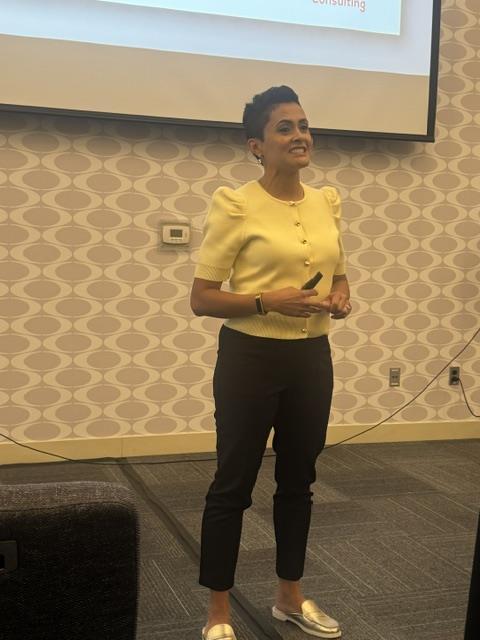
At our regular Club meeting on June 11, 2026, Diana Rogers Jaeger provided an engaging and articulate talk on “Creating Connection Via Appreciation”. Owner of Love to Appreciate Consulting, Ms. Rogers Jaeger helps employers acquire, develop and retain talent.
According to Rogers Jaeger, many top employees feel that they work really hard and never receive a genuine “thank you”. She experienced that when confronted with this, one boss responded “that’s what money is for”. For many American workers, nothing could be further from the truth.
Studies have shown that for younger workers in particular, quality of life is key. According to surveys, some 65% of American workers did not feel that they received any appreciation during the past year. Some 79% of workers who left their jobs cited lack of appreciation as a key factor. Some 81% of those surveyed reported that they are motivated to work harder when their boss shows appreciation. She offered that many studies have shown that appreciation drives numerous worker productivity metrics. To Rogers Jaeger, appreciation is a necessity, not a nicety.
So what does “appreciation” mean in a workplace context? Ms. Jaeger went into the topic in detail. In general, she defined appreciation as a communication or act that makes the recipient feel valued for who they are as well as for what they do. To be effective, appreciation must be meaningful to the recipient.
Jaeger offered that just as there are 5 love languages (per the book by Gary Chapman), there are 5 languages of appreciation. These languages can be described as “Word of Affirmation”, “Quality Time”, “Acts of Service”, “Gifts” and “Touch”. Words of Affirmation must be specific and targeted to the individual. Quality Time involves shared experience with attention to the recipient. Acts of Service involve going above and beyond the giver’s normal work duties to help the recipient in some significant way. Gifts should be personal to the recipient, and touch must be appropriate to the workplace and context. A study shows that the following percentages of respondents cited the following languages of appreciation as the one they appreciate the most:
Language
Pct
Word of Affirmation
47
Quality Time
25
Acts of Service
22
Gifts
6
Touch
4
As a key takeaway, the study demonstrates that different people place different levels of value on different languages of appreciation. Some prefer gifts while others prefer words of affirmation or acts of service. Younger workers tend to prefer affirmation from peers, whereas older workers prefer affirmation from superiors.
Rogers Yaeger concluded by emphasizing that to be effective, appreciation should be genuine, individualized and unexpected. When effectively given, appreciation produces a response that she has labeled “emotional confetti”. This is a burst of joy people feel when genuinely appreciated. The impacts of emotional confetti are that it creates shared energy, signals celebration and spreads happiness.
For more information about Jaeger, her philosophy and services, visit her webpage at www.lovetoappreciate.com.
Mark gives an insightful discussion on the most pressing global issues being addressed at the United Nations. From climate change and food security to peacekeeping and the pursuit of sustainable development goals, this talk will explore the critical challenges shaping our world in a time of turmoil. Gain a deeper understanding of how the UN works to address these issues and what it means for the future of global cooperation.
 Hilton Garden Inn