
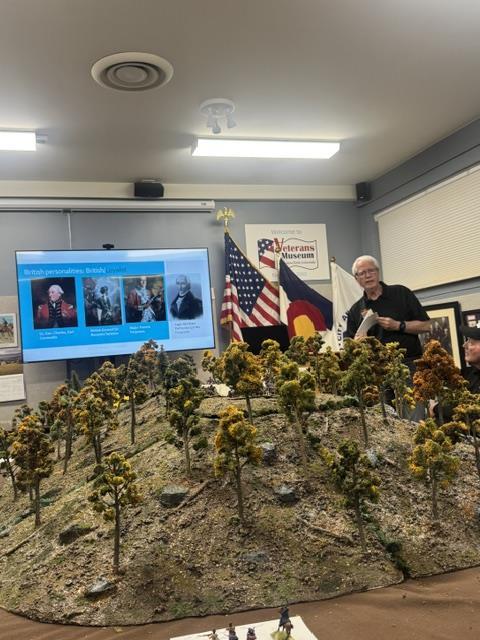
On October 1, 2026, in lieu of our usual social on the first Thursday of the month, we gathered over pizza at the Broomfield Veterans Museum to hear Dave Manley’s presentation on The Battle of Kings Mountain. This famous Revolutionary War Battle was fought on October 7, 1780 in South Carolina. It proved to be a turning point in the Southern theatre of the War and one of the turning points of the entire War. Dave’s re-creation of the battlefield and detailed account of events were riveting and well beyond impressive.
The loyalists, under the command of Major Patrick Ferguson, initially occupied the high ground. The Patriots surrounded the Loyalist encampment and attacked up the hill from all sides. Attacks were followed by retreats and subsequent attacks. Ironically, nearly all of the combatants on the Loyalist side were Americans. As Manley put it, the Revolutionary War was largely a civil war.
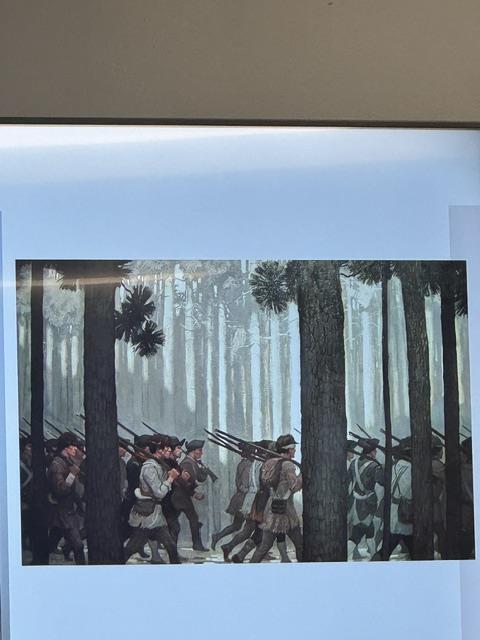
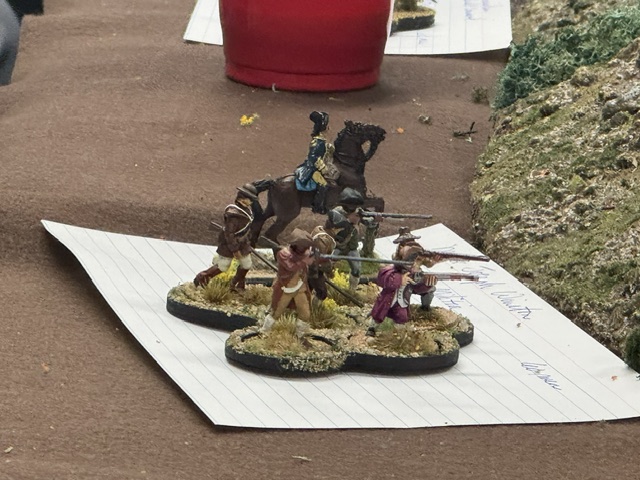
Manley meticulously re-created a detailed model of the battlefield (pictured at top). The model was approximately 6 feet long and about a foot high (my observations). One inch on the model represented 5.5 feet of battlefield. The model included hand-painted figures of soldiers and horses on both sides, also to scale (sample pictured right). Manley also provided paintings re-creating what the battle must have actually looked like (pictured left). The sheer volume of facts and figures Manley effortlessly presented was way beyond anything my old note-taking hand could capture.
In all, the battle lasted only about an hour. The Patriot soldiers were seasoned Indian fighters and used Indian fighting at King’s Mountain. When it was over, the Loyalist army had lost some 1000 men, with about 700 having been captured and the rest killed or injured (again, all of this in an hour). Captured Loyalist soldiers were forced to march carrying weapons and other booty the Patriots had seized. Many of the Loyalists who surrendered were later killed. As mentioned, this battle is widely regarded as a turning point in the Revolutionary War. Cornwallis (Commander of British forces) would surrender at Yorktown only about a year later.