
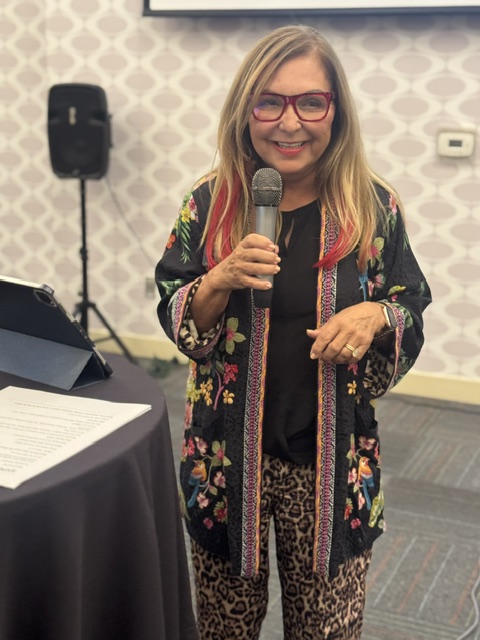
At our regular Club meeting on September 17, Cindy Chase, District Governor for District 5450, offered a thought-provoking challenge about the future of Rotary Clubs in general and our Club in particular. Ms. Chase came to Rotary after founding the Aspen Insurance Agency. She built up the agency over a period of 30 years and sold it some 6 years ago. She joined the Denver Cherry Creek Rotary Club in 2017. For Ms. Chase, one of the attractions of Rotary was its fight against Polio, a disease which had afflicted her father. As she joined the fight against Polio, she came to realize that the fight served many underserved parts of the World. Per the District 5450 web site, during 2022-2023, Chase served as the President of the Denver Cherry Creek Rotary Club. She currently serves as Denver Cherry Creek Foundation and Membership Chair, District Polio Committee member, and is on the Epic Day of Service team. She is a Paul Harris Fellow +7. Chase shared some of the ideas from this year’s Rotary International Convention in Tai Pei.
Her main theme was recruiting and retaining new members. Chase began by asking the members in attendance, “what do you like about Rotary”? Most responded that they like the friendships and the chance to get involved with the community. She then pivoted to the question that clubs must now ask themselves, “am I still relevant”? She noted that the Broomfield Rotary Club was founded in 1958. She shared some observations about how much the World around us has changed since 1958. Then she posed to us the question, how much has the Club changed since then? Has the Club changed as much as the world around it has changed? For those of us who have been affiliated with this Club for a long time and knew some of its original members, that was a challenging and not entirely flattering question. I suspect Chase knew the answer to this question before she posed it to us.
Chase then focused on the path forward. Her key point was that in recruiting new members, we should not just think about just increasing membership numbers. Rather, Rotary Clubs should think of recruitment as succession planning. We should be asking ourselves, “when all of the current members of this Club are gone, what will the future Rotary Club of Broomfield look like?” Are we making room not only for new people, but also for new ideas? She suggested that rather than merely invite people to Rotary meetings, we Rotarians should expand our horizons and meet prospective members where they currently can be found, such as at service projects, Chamber meetings and other venues. Once a rapport has been established, the prospective members might express curiosity about Rotary, opening an opportunity for an explanation and an invitation to visit the Club. She posed the question, if you were a professional in your 30s or 40s with all that entails today, what would you want to get from membership in a Rotary Club? Why would you want to belong? The key to succession planning, as Chase sees it, is to create a place where future Club leaders see themselves belonging. She again posed challenging questions. Are we seeking people who will lead the Club tomorrow? What kind of Club would we like future leaders to carry forward? What parts of the current Club experience would we keep? What parts should we discard?