
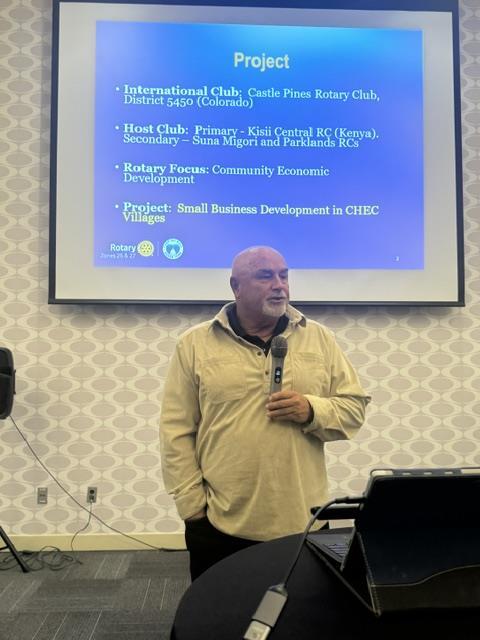
At our regular Club meeting on November 12, 2026, we were treated to an engaging presentation by Blair Gifford, Ph.D., about ongoing projects in Kenya. Dr. Gifford currently is a Professor Emeritus in the Business School at University of Colorado’s (CU’s) Denver Campus and an Honorary Professor at CU’s Anschutz Campus. He also serves as Assistant Governor for Rotary District 5450 and is a member of the Castle Pines Rotary Club. Dr. Gifford is the Founder of Global Heath Connections, a non-profit that helps rural Kenyan villages achieve self-sustainability via Community Health and Empowerment Clubs (CHECs). The CHEC model provides 24 months of training and assistance to rural Kenyan villages. The training and assistance has three general topics: health, financial literacy and leadership. After the training and assistance has been completed, the trainers step back. The goal is to help the village become permanently self-sustaining. U.S. Rotary clubs work with a host club in Kisii, Kenya. Currently, some 10 Rotary Clubs in Colorado, Illinois and California have each “adopted a village”.
The first training phase, health, covers topics such as proper hand washing, personal hygiene, dehydration, safe water and water storage, and how to build and maintain latrines. Health training also includes community gardening, where locals work in teams. Often, this training enables trainees to produce enough food not only to feed themselves and their families, but to create a new income stream by bringing excess food to market elsewhere.
The second phase covers finance. Finance comes after health because experience has shown that if the CHECs offer finance first, a fair number of the locals will stop attending the training after the finance training is over and will skip the health training. Health is critical to sustainability. Therefore, the CHECs tend to treat finance training as a reward for completing the health training. As an example, before training, most of the villagers live entirely off cattle (meat and milk are main staples). The training includes things such as raising and harvesting chickens.
The third phase of the training covers leadership and governance. This helps villagers sustain the practices they learned earlier. After trainers complete the 24 months, they leave. However, the trainers remain available to the trained villagers indefinitely for consults by phone or other media. CHECs are evaluated via quantitative measurements over time, but Dr. Gifford did not spend much time on the particular statistics used.
Dr. Gifford reported that the unemployment rate in Kenya is about 65%! Additionally, media such as televisions and cell phones are relatively scarce, particularly in rural Kenya. Some 85% of villagers receive their “outside” information (information from outside the village) via radio. Given that environment and the abject poverty of these villages, CHECs tend to have a huge impact on the villages they assist. Further, the cost of a CHEC tends to be about one fifth of the cost of top-down aid that produces similar results.
CU has gotten involved. Currently CU has a medical research campus in Guatemala and there is talk of a similar campus in Kenya in the near future. Why would the University of Colorado System spend money to have a presence in these countries? CU has determined that a certain volume of its students want to help “change the world” by assisting people in Third World countries. People like Dr. Gifford, with a wealth of experience in the rural Third World and particularly in Kenya, help make that possible.